Website examples
Small business website examples that bring in work
A good site is not the one with the most on it. It is the one that says what you do, loads in a second, and turns a visitor into a call. Here is what that looks like, by sector, with real builds.
The direct answer
The best small business website examples all share the same handful of things, and none of them is fancy. In the first second, the page tells you what the business does and where. It loads instantly on a phone. It shows real photos of real work. And it makes getting in touch a single tap, whether that is a call or a message. A site that does those four things well beats a bigger, prettier one that does not, because it is the one that actually gets the phone to ring.
What you will not find in a good example is clutter: no sliders full of stock images, no ten-second load, no hunting for a phone number. Most small business sites underperform not because they are missing features but because they bury the simple things that matter under the things that do not. Below is what good looks like, and where to see it by trade.
What a good small business website actually does
Strip it back and every strong example does five jobs. It states the service and the area plainly, so a visitor and Google both know what it is. It loads fast, because speed keeps visitors and helps rankings. It proves the work with real, own photos rather than stock. It makes contact effortless, with tap-to-call and a message button always in reach. And it is built to be found, with sensible page titles and a tidy structure. Get those five right and the design can be simple; get them wrong and no amount of polish saves it.
Small business website examples by sector
What a great site needs shifts with the trade. A pressure washer lives or dies on before-and-after photos; a plumber needs to load instantly and be one tap to call in an emergency; a window cleaner is selling a recurring round, not a one-off. Each of these pages shows what a strong website looks like for that specific trade, and why.
Websites for pressure washing
Before-and-after is the sell.
Websites for driveway & patio cleaning
Block paving, resanding, kerb appeal.
Websites for gutter cleaning
Seasonal and semi-urgent.
Websites for window cleaning
Built to fill your round.
Websites for roofers
Trust, accreditations, real job photos.
Websites for plumbers
Emergency-ready. First to answer wins.
Websites for electricians
Certification front and centre.
Websites for joiners & carpenters
Craftsmanship shown in a portfolio.
Websites for plasterers
Finish quality, before and after.
Websites for painters & decorators
Transformation photos, tidy in the home.
Websites for tilers
Precision finish, bathroom and kitchen work.
Websites for flooring
Product ranges and finished-room photos.
Websites for fencing & decking
Seasonal, storm-driven, garden projects.
Websites for landscapers & gardeners
Visual projects and repeat maintenance.
Websites for tree surgeons
Safety, insurance, storm emergencies.
Websites for damp proofing
Diagnosis, guarantees, survey-driven.
Websites for domestic cleaning
Recurring, trusted, in the home.
Websites for pest control
Urgent, discreet, reassuring.
Websites for removals
Date-driven, trusted with belongings.
Websites for skip hire
Fast, transactional, price-clear.
Websites for house clearance
Sensitive, discreet, licensed.
Websites for accountants
Credibility and an ongoing relationship.
Websites for bookkeepers
Reliable, local, ongoing support.
Websites for it support & msps
Responsive, secure, contract-based.
Websites for mortgage brokers
Credibility and reassurance.
Websites for solicitors
Trust, expertise, area of law.
Websites for architects
Portfolio, vision, planning know-how.
Websites for surveyors
Qualifications and trust.
Websites for planning consultants
Expertise navigating planning.
Websites for florists
Occasions, visual, local orders.
Websites for barbers
Footfall, regulars, easy booking.
Websites for hairdressers
Fill the chair, style gallery.
Websites for beauty clinics
Treatment menu, booking, trust.
Websites for dog groomers
Booking, trust with your dog.
Websites for driving instructors
Pass rates, booking, local.
Websites for personal trainers
Results, booking, presence.
Websites for photographers
Portfolio, style, occasions.
Websites for caterers
Menus, events, booking.
Websites for mechanics
Trust, MOT and repair, found when it breaks.
Websites for mobile mechanics
We come to you. Catchment and convenience.
Websites for car body repair
Insurance and private, before and after.
Websites for alloy wheel repair
Quick cosmetic fix, lease returns, mobile.
Websites for auto electricians
The fault others can't find. EV and diagnostics.
Websites for auto locksmiths
Locked out, keys lost, roadside now.
Websites for car valeting
Regular, mobile, a showroom finish.
Websites for car dealers
Stock enquiries and the trusted independent.
Websites for caravan dealers
Enthusiast market, wider catchment.
Websites for taxi companies
Easy booking, airport runs, accounts.
Websites for heating engineers
Gas Safe trust, and heat that's gone off.
Websites for boiler installers
The considered replacement, quotes and finance.
Websites for boiler repair
No heat, cold snap, first to answer wins.
Websites for heat pump installers
MCS, grants, the researched green switch.
Websites for air conditioning
Install, commercial, the summer spike.
Websites for solar panel installers
Payback maths, MCS, energy independence.
Websites for ev charger installers
Home chargers, grants, a growing market.
Websites for builders
Big-spend trust, a portfolio, references.
Websites for construction companies
Commercial, B2B, capability and tenders.
Websites for bathroom fitters
The transformation, before and after.
Websites for kitchen fitters
Design-led, the heart of the home.
Websites for bedroom fitters
Fitted wardrobes, made to measure.
Websites for loft conversions
Space instead of moving, the ROI.
Websites for driveway installers
Kerb appeal, resin and block paving.
Websites for artificial grass
No more mowing, before and after.
Websites for groundworkers
The reliable subbie who won't hold up the site.
Websites for shopfitters
Commercial fit-out, portfolio, project.
Websites for glaziers
Emergency boarding-up and glass repair.
Websites for window fitters
Double glazing, energy and finance.
Websites for garage doors
The range, security and kerb appeal.
Websites for handymen
The local go-to for the small jobs.
Websites for swimming pools
High-value, visual, the dream project.
Websites for structural engineers
Calcs, certification, referral-backed.
Websites for roof cleaners
Moss off, kerb appeal, protect the roof.
Websites for render cleaning
Softwash, not jet-wash, green off the walls.
Websites for carpet cleaners
Stains gone, end-of-tenancy, before and after.
Websites for chimney sweeps
Seasonal, safety certificate, trust in the home.
Websites for appliance repair
Same-day fix, cheaper than replacing.
Websites for security companies
Monitored alarms, protection, reassurance.
Websites for cctv installers
Deterrence and evidence, home and business.
Websites for fire alarm installers
Compliance, legal duty, commercial.
Websites for locksmiths
Locked out now, and lock upgrades.
Websites for commercial cleaners
B2B contracts, offices, reliability.
Websites for waste removal
Same-day clearance, licensed, no skip needed.
Websites for self storage
Local, unit sizes, convenience.
Websites for couriers
Same-day, reliable, B2B accounts.
Websites for asbestos removal
Licensed, survey-driven, reassurance.
Websites for estate agents
Win instructions, valuations, local trust.
Websites for commercial property
Investors and businesses, B2B credibility.
Websites for property management
Landlords, hands-off, compliance.
Websites for financial advisers
Trust with money, long-term relationship.
Websites for insurance brokers
Human advice over comparison sites.
Websites for business consultants
Results and credibility, case studies.
Websites for energy consultants
Commercial savings and compliance.
Websites for recruitment agencies
Two-sided, sector niche, credibility.
Websites for marketing agencies
Your own site is the proof.
Websites for design agencies
Brand and identity, portfolio-led.
Websites for graphic designers
Freelance, personal portfolio, style.
Websites for seo agencies
Practise what you preach, ranking proof.
Websites for video production
The showreel, storytelling, portfolio.
Websites for interior designers
Aspirational spaces, style, portfolio.
Websites for printing companies
Fast quotes, range, turnaround.
Websites for event planners
Occasions, portfolio, trust.
Websites for tutors
Results, trust with children, subjects.
Websites for dance schools
Timetable, enrolment, kids and community.
Websites for day nurseries
Deep trust, Ofsted, waiting lists.
Websites for home care
Trust with a loved one, dignity, CQC.
Websites for funeral directors
Compassion, dignity, quiet trust.
Websites for charities
Mission, donations, volunteers, trust.
Websites for dentists
Nervous patients, booking, cosmetic.
Websites for physiotherapists
Recovery, injury, back to movement.
Websites for chiropractors
Pain relief, reviews, ongoing care.
Websites for osteopaths
Whole-body, holistic, regulated.
Websites for acupuncturists
Demystify, reassure first-timers.
Websites for opticians
Eye tests, eyewear, local and family.
Websites for pharmacies
Local, services beyond dispensing.
Websites for vets
Pets as family, emergency and routine.
Websites for restaurants
Menu, photos, direct bookings.
Websites for cafes
Daytime, footfall, atmosphere, discovery.
Websites for bars
Nightlife, what's on, private hire.
Websites for pubs
The local: food, events, function room.
Websites for takeaways
Commission-free ordering, own your customers.
Websites for pizza restaurants
Dine-in and delivery, beat the app cut.
Websites for bakeries
Local, footfall, morning trade and orders.
Websites for cake makers
Celebration cakes, visual, occasion orders.
Websites for private chefs
In-home dining experiences, occasions.
Websites for farm shops
Provenance, footfall, a destination.
Websites for hotels
Direct bookings, beat the OTA commission.
Websites for b&bs
The personal welcome, direct bookings.
Websites for holiday lets
Self-catering, direct, keep the fees.
Websites for gyms
Convert visitors to members.
Websites for yoga studios
Class booking, calm, beginners welcome.
Websites for golf clubs
Members, visitors, societies and functions.
Websites for sports clubs
Membership, juniors, fixtures, community.
Websites for nail salons
Booking, a visual gallery, regulars.
Websites for antique dealers
Stock to distant buyers, valuations.
Websites for auctioneers
Catalogues, buyers and sellers, valuations.
Websites for pet boarding
Trust with pets, seasonal booking.
Websites for builders merchants
Trade accounts, range, local.
A real example: the pressure washing build
The clearest example on this site is Isle Jet It, a pressure washing business on the Isle of Wight whose site now ranks number one on Google for its local searches, with no paid ads. It is a plain, fast site built around the work, and it did the one thing a website is for: it brought in enquiries. The full story, the build, the approach and the result, is in the case study.
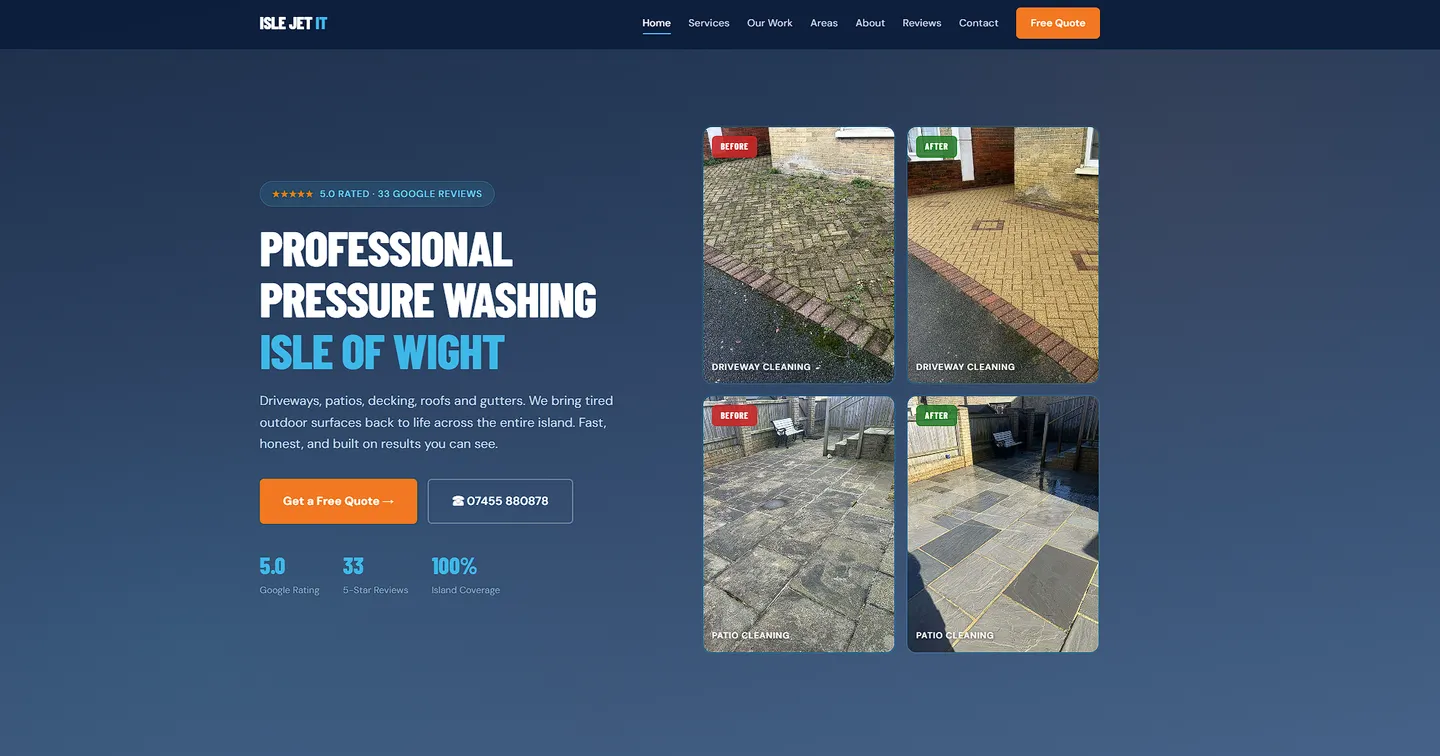
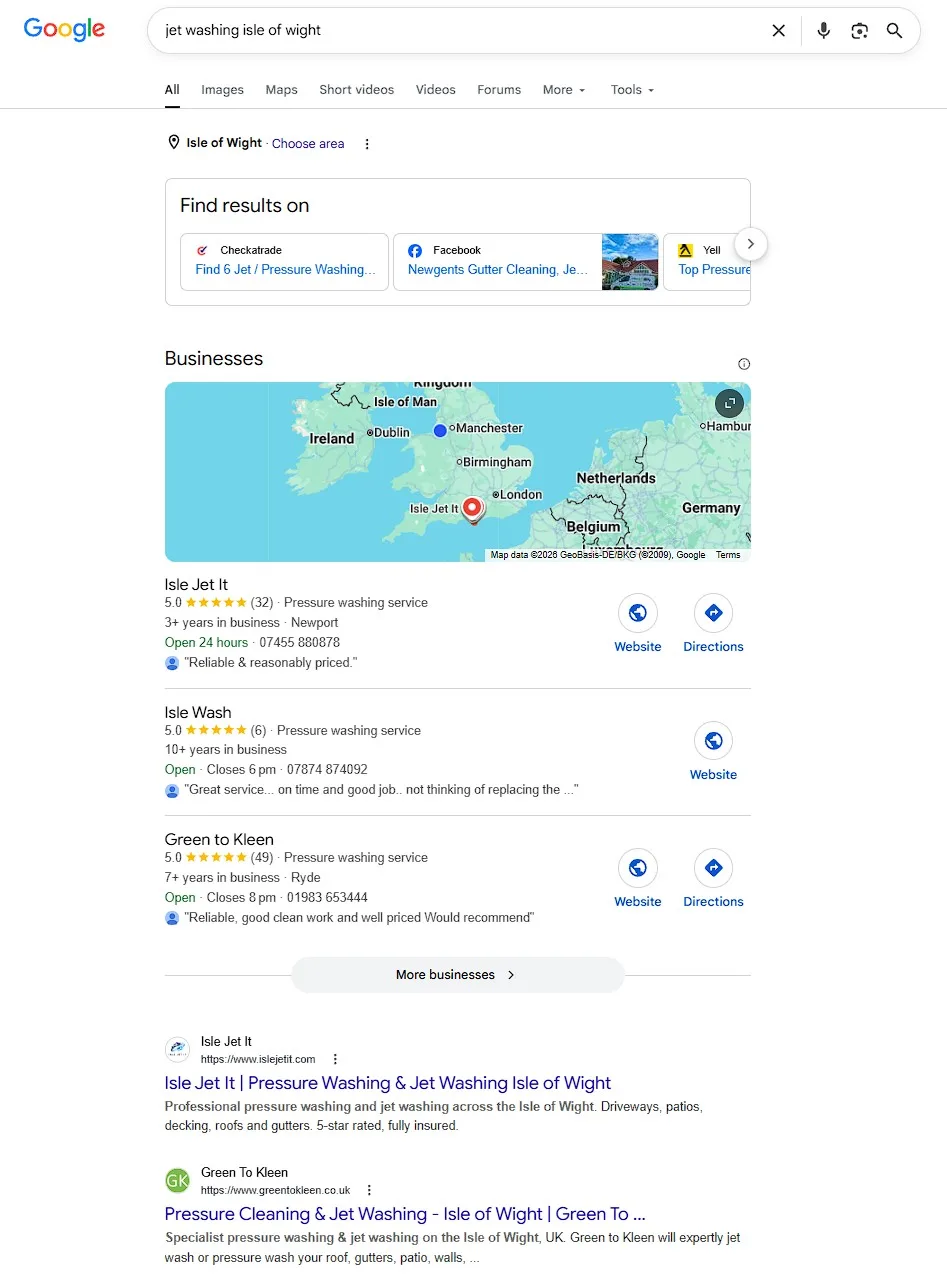
Read the pressure washing case study, or see more on the work page.
How to judge a website example
When you look at a website, yours or a competitor's, it is easy to be swayed by how it looks and miss what actually matters. Here is the test I would apply. Open it on your phone and count the seconds until it is usable; more than about three and it is losing people. See how many taps it takes to call or message; it should be one. Check whether, in the first line, you can tell what the business does and where. Look for real photos of real work rather than stock. And search the trade plus the town on Google and see whether the site even shows up. A site that passes those five is a good example whether or not it wins a design award. One that fails them is a bad example no matter how smart it looks.
Different sectors, different examples
A good example for one kind of business is a poor one for another, because the job the site has to do changes with the sector. For a trade like a plumber or a roofer, the example that works is fast, trust-heavy and one tap to call, because the customer is often urgent or wary. For a home service like pressure washing or window cleaning, it is visual and local, leaning on before-and-after proof and the area covered. For a professional service, an accountant or a solicitor, it is about looking credible and trustworthy and being easy to find, because there is no directory to rent leads from and the whole game is reputation. For a local shop or a personal service, it is about filling the diary and drawing people in. Judge an example against its sector's job, not against a generic idea of a nice website.
The photos are half the example
On most of the strongest small business sites, the single biggest thing setting them apart is not the layout, it is the photography. Real photos of real work, taken on a phone but taken with a bit of care, do more to win trust than any amount of copy. A pressure washing site with genuine before-and-afters, a roofer with tidy finished jobs, an electrician with a neat consumer unit: these show the standard in a way words cannot. When you look at an example you admire, notice how much of its impact comes from showing real work rather than describing it. Then notice how the weak ones fall back on stock images of people who do not exist, which fools nobody and quietly costs them credibility.
What good looks like versus a template
It is worth being clear about what separates these examples from the cheap template sites most small businesses end up with. A template is assembled from generic blocks, carries the weight of a page builder, and looks like a hundred others in the same trade. It can be online quickly, but it is usually slow, hard to change, and forgettable. A properly built site is lighter, faster, written for your customers rather than filled with filler, and made to be found. The difference does not always show in a screenshot; it shows in the load time and in whether the phone rings.
Fast beats fancy, every time
If you take one thing from looking at examples, make it this: speed wins. A plain, fast site beats a beautiful, slow one for the simple reason that the fast one is still on screen when the beautiful one is still loading. Your customer is usually on a phone, often on patchy signal, and rarely patient. Every second a page takes to appear loses a chunk of the people who arrived. The examples on this site load more or less instantly because they are static and light, with no page-builder bloat and properly sized images. That is not a technical detail for its own sake; it is the difference between a visitor who calls and one who taps back to the search results and picks the next name. When you weigh up examples, weigh the load time as heavily as the look, because your customers do.
The objections I hear
"My competitor's site looks fine to me." Maybe, but look again on your phone and time how long it takes to load and how many taps it is to call them. That is the test that matters, and a lot of fine-looking sites fail it.
"I just need something simple." Good, so do most businesses. Simple and fast is the goal, not a sprawling site. Simple done well is harder and more effective than big done badly.
"I had a website before and it did nothing." Then it probably failed one of the five jobs above, most often speed or clarity. A site that does nothing is not proof that websites do not work; it is proof that one was built badly.
Use these examples as a brief, not a mould
The point of looking at examples is not to copy one, it is to work out what yours needs to do. Notice what the good ones get right, the clarity, the speed, the real photos, the one-tap contact, and make sure yours does the same. But your site should be built around your trade, your area and your customers, not stamped from the same template as everyone else in your line of work. That is the whole reason the sector pages on this site exist: to show what good looks like for your specific trade rather than in the abstract. Take the examples as a checklist of what matters, then have a site built that meets it in your own way.
What it costs to get one like these
It is from £297 to build, live in 7 days on your own domain, with the first three months of Care included, then £49 a month. You see the finished site before you pay the rest, and you own it. The difference from a template is not the price, it is whether the thing you end up with actually brings in work.
Common questions
Examples, answered.
What does a good small business website look like?
Clear, fast, and built to turn a visitor into a call. In the first second it says what you do and where, it loads instantly on a phone, it shows real photos of your work, and it makes getting in touch a single tap. Everything else is detail. A good site is not the one with the most features, it is the one that gets the phone to ring.
Can I see examples of sites you have built?
Yes. There is a live build to look at (islejetit) and a full case study on a pressure washing site that reached the first page of Google. More go up as they launch. I only show sites that are actually live, never mock-ups or stock designs dressed up as client work.
Should my website look like my competitors'?
It should do the same core things well, but it should not be a clone. Most small business sites in a given trade look identical because they came off the same template. Standing out a little, with your own photos, your own words and a genuinely fast site, is part of what wins the click over the next name on the list.
Do I need a big website with lots of pages?
No. For most trades and local businesses a focused handful of pages does the job better than a sprawling one. A clear home page, a page per main service, proof of your work and an easy way to get in touch. Size is not the point; clarity and speed are.
What makes a website slow, and why does it matter?
Usually heavy page builders, WordPress plugins and oversized images. It matters because a slow site loses visitors before it loads and Google ranks it lower. The examples that work are static and light, which is why they load instantly. Speed is not a nice-to-have, it is part of whether the site earns its keep.
How much does a website like these cost?
From £297 to build, live in 7 days on your own domain, with the first three months of care included, then £49 a month. You see the finished site before you pay, and you own it. Full detail is on the pricing page.
Examples for your trade
See the site I'd build for you.
-
Trades
Own your leads instead of renting them off a directory. Built for emergency call-outs and high-ticket work, on your own domain, live in 7 days.
-
Home services
Get found for the jobs happening on your street. Visual, seasonal, recurring work, shown off and easy to book, live in 7 days on your own domain.
-
Professional
Look as credible as you are and win higher-value clients. No directory to lean on here, just being found and trusted, on a fast site that is yours.
-
Local business
Fill the diary and drive footfall without paying per booking. Booking-led and occasion-led work, shown off and easy to choose, on a site you own.
Keep reading
Related reading.
Want to see what yours would look like? I build it on spec, so you see the finished site before you pay.